top of page
  • Etsy
  • Instagram

Entry #20: Thomas Jefferson's Monticello

Updated: Apr 29

Thomas Jefferson's Monticello - his historic home sits decorated for the US' 250th Anniversary.

To celebrate my husband's birthday - and enjoy a rare weekend getaway - we decided to visit Thomas Jefferson's Monticello in Charlottesville, Viriginia.


Waving goodbye to our daughter Jordan (who held down the fort and the Etsy shop) we hopped in the car on Thursday, excited with everything we'd planned. Jordan found and booked us a hotel, a ghost tour, a behind-the-scenes tour of Monticello itself, bakeries (for my husband's cake), and antique stores - we practically just had to pack our bags and get in the car. A three-and-a-half hour car ride later, and we were gently snaking through the softer edge of the Blue Ridge Mountains.


A photo of the Blue Ridge Mountains from a lookout; there are trees, winding meadows, and a blue haze settling over the rolling peaks beyond. The trees are leafed out, so there is a sea of waving green in the valley below.
Another photo from the lookout of the Blue Ridge mountains with a hazy blue mist over the rolling peaks; there are more clear-cut meadows between all the green trees; houses dot the landscape.

We're no stranger to the Blue Ridge, as Jordan went to college in Swannanoa, but every time I look at those mountains, they take my breath away. We pulled over at an overlook at take it all in!


A hop, skip, and a jump later, and we found ourselves in Charlottesville, Viriginia! I didn't take any photos because we were just so tired that once we got to the hotel, we fell right into bed and didn't wake up until Continental Breakfast was halfway over. After fueling up, we made sure we had all our tickets, and made the five minute drive to Monticello.


The half-shaded brick walkway towards the visitor greeting center, museum, and gift shop,which was once home to slaves.
A once slave home is now a museum and gift shop.

We arrived early for our tour, so we took the chance to walk around and check out the museum/gift shop first.


A pink/red transferware dinner plate showing Monticello and big peony floral designs around the rim.
A standing writing desk where Jefferson penned the Declaration of Independence.
The desk where Jefferson actually penned the Declaration.
An original Declaration of Independence kept in a gold frame and constantly temperature/humidity controlled.
An original Declaration of Independence (many were written/copied at the same time)
Pieced together dinner plates featuring transferware designs as well as a chamber pot!
Selections from Martha Skelton's (Thomas Jefferson's wife) things. One being a sewing bag (featuring four different patterns) a time piece, spoons, a key, and a small wooden purse.
Jefferson's wife, Martha Skelton's, sewing kit (the patterned bag).
Thomas Jefferson's shaving razor, as well as a painting of him in an ornate golden frame.
Many transferware bowls and small vessels that have been pieced back together.

I was amazed at all the pottery and transferware! How carefully it must've been reconstructed, and how exciting it must've been to find for the archeologists.


Just before we arrived at Monticello, archeologists found a brick kiln on the east lawn, which they dated to 1770 (read about it here!), and the excitement was palpable! Though we didn't run into any students or see very much excavation, our docent reported that Monticello sees between 700 and 800 students a day. They come from all over, in conjuction with the very close University of Virginia (UVA); her favorite being a group of students who arrived on a red-eye flight from California - she loved them because they were very, very quiet. We laughed at that.


An alcove bed staple from a guest bedroom in Monticello, and an example of how it was used.
A lapdesk/travelling desk of Jeffersons, as well as his handwritten notes.
Models of Roman askos, used for pouring wine and oil. One is mahogany and the other is silver.
An informational plaque about threshing wheat at Monticello.
I believe this is a conveyor for threshing wheat.
More transferware that has been pieced together, along with a brown glass bottle and a rusted cup that have been found on the grounds.
A painting kit, time pieces, and a book that have been found on the grounds.
Seed vials, a hand mangnifier and excavated corn kernels. The hand magnifier belonged to Jefferson.
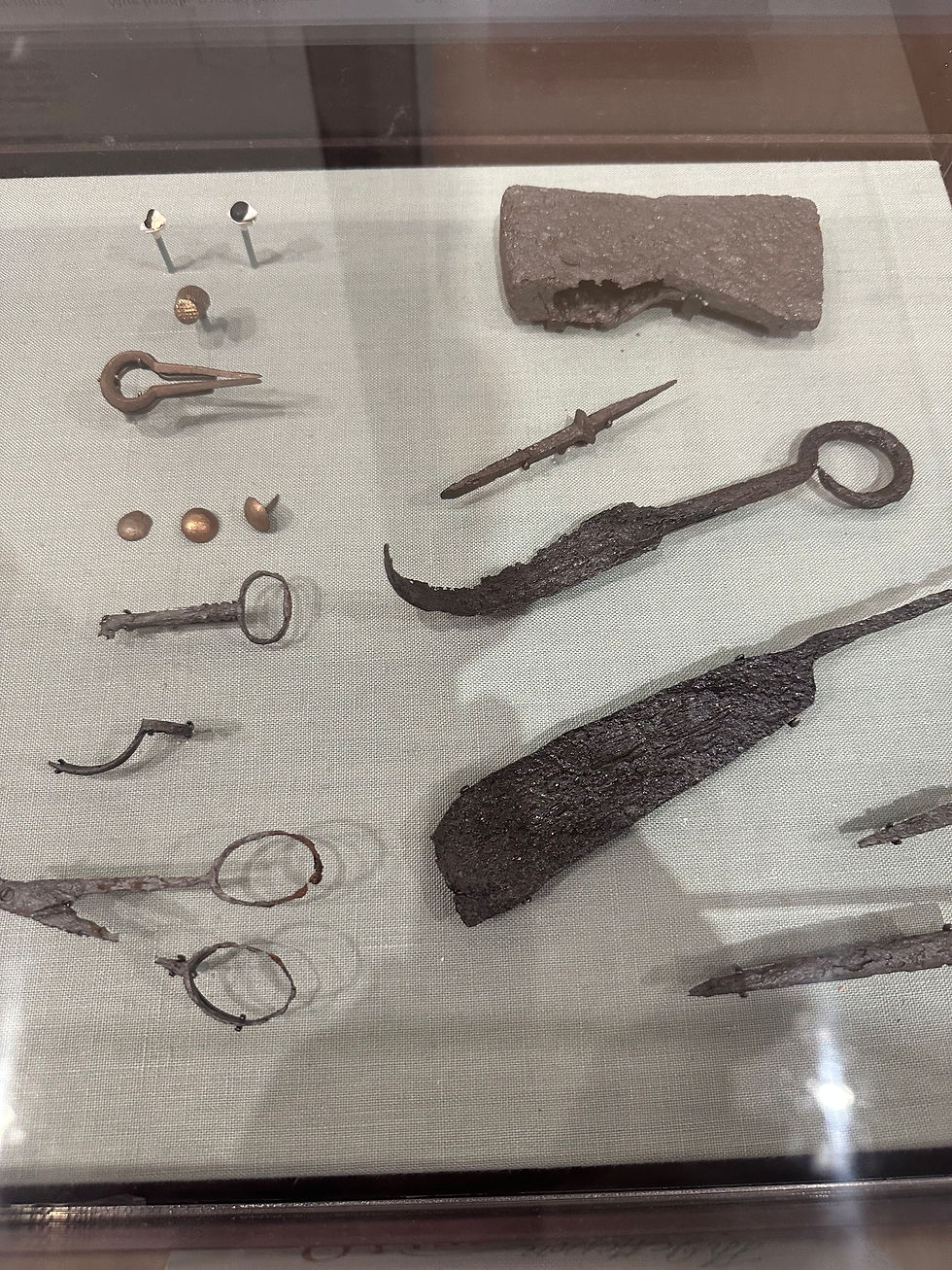
Various metal tools and implements excavated from Monticello's grounds.
Further shards and pieced together bits of transferware, creamware, and pottery.
Pieced together bits of a black transferware teacup, and a creamware plate.
More glass cases of transferware and creamware pieces found on the property.
Almost a whole dinner setting found on the property, including a nearly complete blue transferware plate.
The informational plaque about Monticello's transferware and its distinctions.

This was all such an absolute treat to see. It is so fascinating how transferware was so beloved then, and still is today - Jefferson even had black transferware cups! And blue plates, most patterns of which not just survive, but are extremely popular right now. This also goes to show just how tough ironstone can be.


Next, we stepped over to the gift shop.


A whole lot of blue-and-white things. From napkins and plastic plates, to actual plates, vases, and glassware. All for sale.
Further blue-and-white patterned things. From Blue Willow plates used inside Monticello to 'thank you' cards, glassware, wicker ginger jars and cupholders, all in differing designs.
More cobalt blue, clear, and blue-and-white glassware, ginger jars, plates, napkins, cards, and vases.
Shelves of various cross-stitch kits - both completed and not - some are in gold frames and availible for purchase, others sit in wicker baskets. There are also felt, embroidered Betsy Ross ornaments.

I wanted just about one of everything, but I didn't get it, sadly, as I knew I would have to carry it around the whole tour - still it was beautiful! The cross stitch kits were of particular interest, how sweet and beautiful! If I had space on my walls, I would do one and hang it up.


After visiting the gift shop, we stepped outside to see the gardens and surrounding buildings.
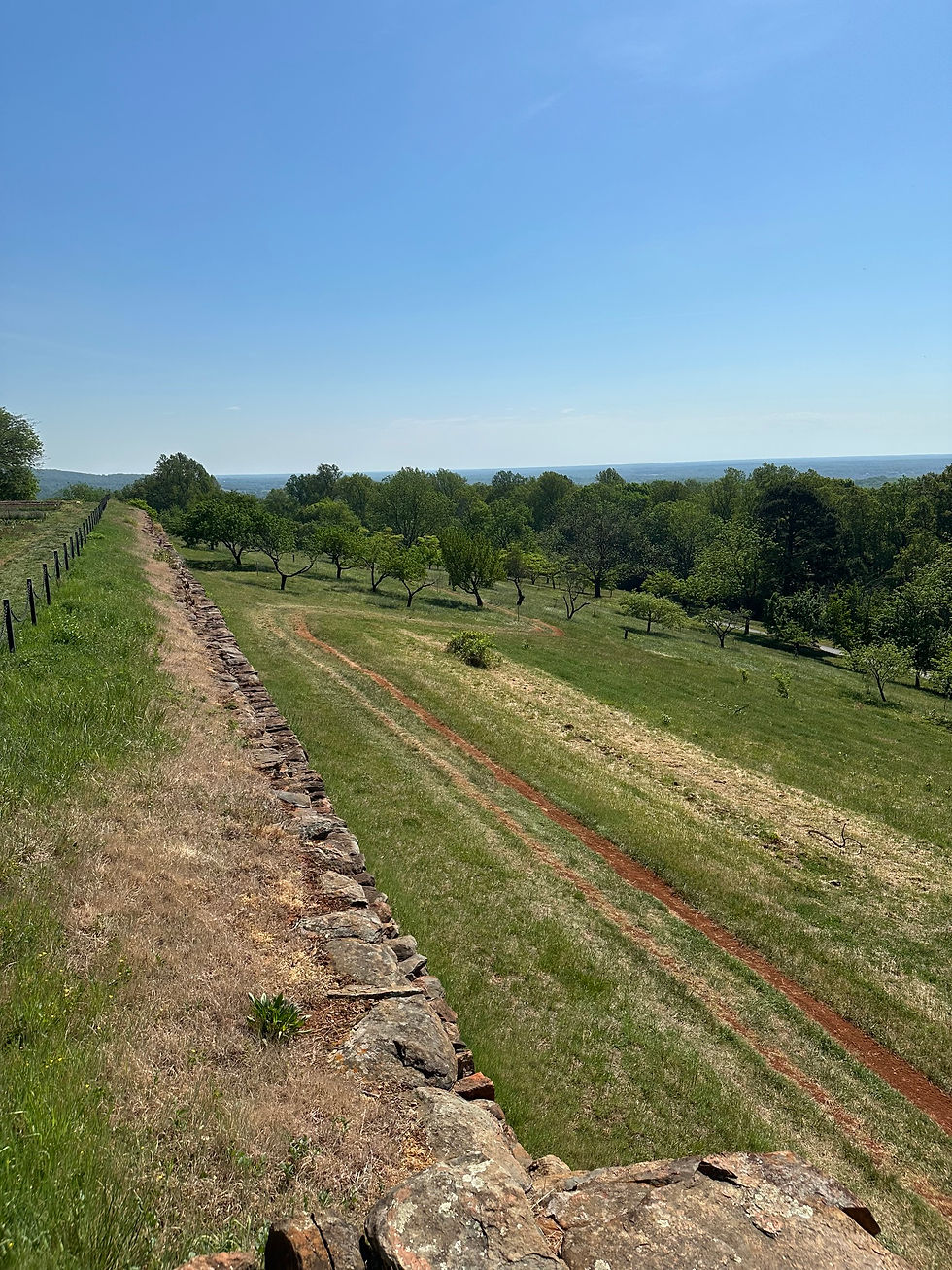

Monticello's hillside garden.
A view of the bushes and trees leading down the mountain into the valley below; there are so manny shades of green that it's almost impossible to name them all.
A sea of green.
More of Monticello's gardens, fenced off with wood. A small building sits in the distance, at the foot of a rolling hill which acts as a place to rest while walking about or working in the gardens.
That small building was AMAZING. Both windows are open for a cross-breeze; it was built to be a rest area on hot or incliment weather days. We stopped in for shade, and the gardener joined us!
Monticello's vinyard.
Grape fences for the vinyard!
A patch in the garden that's sprouting!
I don't quite remember what was in this patch, but just beside it is celery.
A look inside the metal/Blacksmith shop with a truly giant bellows.
A chainmail and leather shirt.
Mulberry trees on Monticello's famous Mulberry Row in full leaf.
All trees like the most prominent one here are Mulberry trees.
A placard about Mulberry Row.
Two very large Blue Willow patterned transferware trays.
Blue Willow trays! They appear small here, but were at least 20" x 15" in person.
Further transferware (creamware) trays inside of a home on Monticello grounds.
A stack of transferware bowls in blue-and-white.
I just couldn't believe what wonderful condition this piece was in! Who knew Jefferson had so much blue and white?
A spinning wheel set up near the fireplace.
A loom.

This was so amazing to see; the gardens were fully functional and very busy! They were lush, and I felt like I was swimming in a sea of green, all the different shades almost hurt my eyes, they were so beautiful. The topic of enslaved individuals was also handled with tact, respect, and much care throughout the property, without glossing over that point in history and in Jefferson's life. Artifacts were carefully preserved in their original buildings, with incredible amounts of information!


Finishing up there, we made our way to Jefferson's grave.


The wrought iron and highly ornamented gate which leads to the Jefferson family cemetary on Monticello.
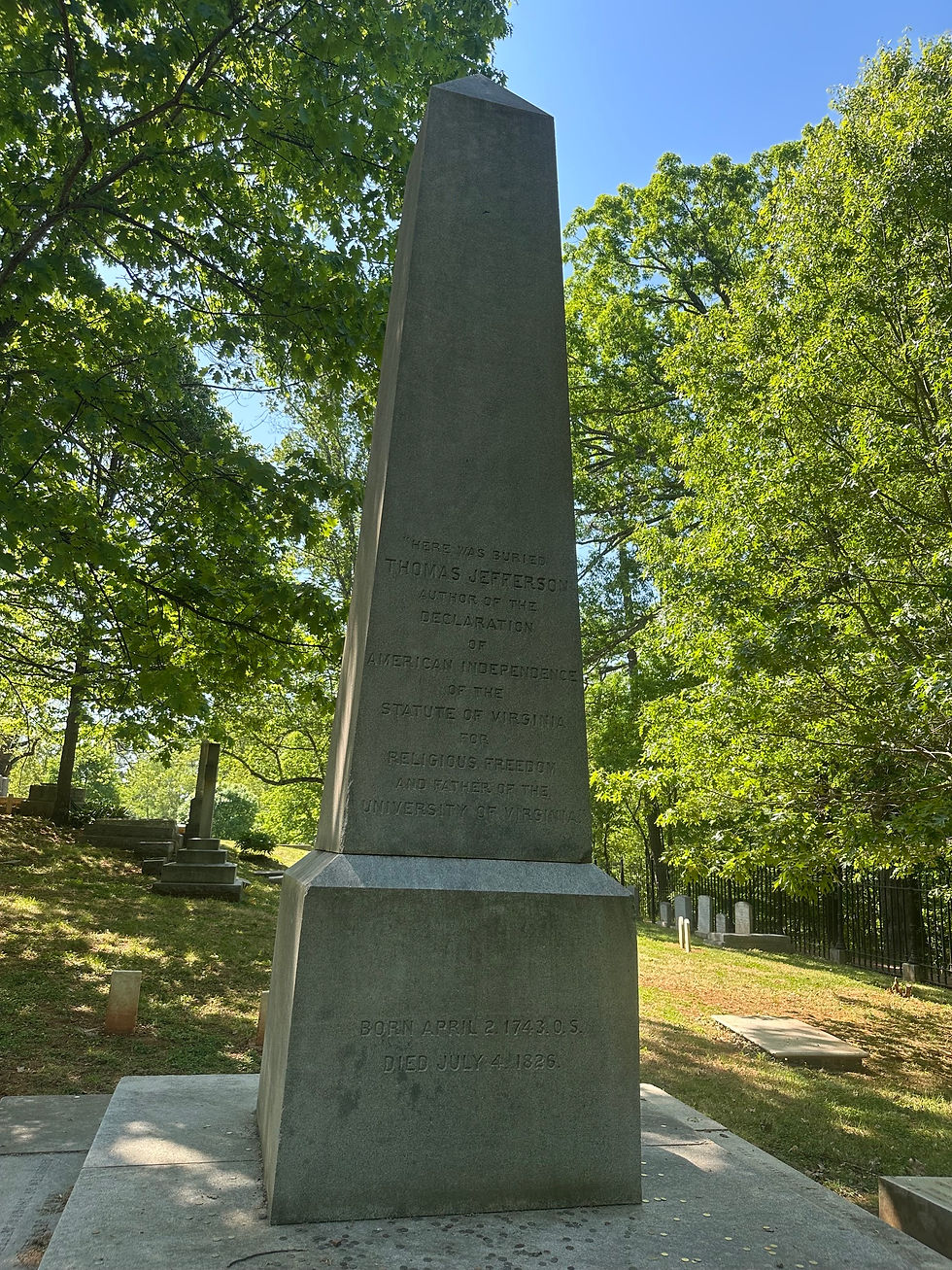
Thomas Jefferson's grave, nickels surround the foot of it, placed there by patrons in homage to him and his life.

The graveyard itself is beautifully shaded with big, old trees, and filled with Jefferson's family. If you notice at the foot of Jefferson's grave, people have laid nickels in homage (if you've never noticied, Monticello is on the US nickel!); we also put a few down.


Then, it was time for our tour! Jordan booked the Behind-the-Scenes tour of Monticello for us, so we headed back up towards the home, gathering with our group, and walked inside.


Monticello with a bunch of people in front of it.
The right side of Monticello/the West enterance, which one would walk through if they were a guest of Jefferson's.
The beautiful mountains in the distance, when looking out from Monticello hill.
Under the roof, on the steps of Monticello his a compass rose that Jefferson attached to a weather vane to tell him which way the wind blew.
This is a compass rose, but the interesting thing about it is that Jefferson had it attached - through the roof - to a weather vane. So he only had to step outside and look up to see which way the wind was blowing!
One of many walls of curiosities in Jefferson's public/guest enterance.
The enterance room. At the time, Jefferson would've had the walls FULL to the brim with curiosities; the docent said guests could wait there for hours, so Jefferson kept not even an inch of space on the walls between all the eclectic things he had. From taxidermy to contraptions, maps, paintings, busts, Indigenous artifacts, and things Lewis and Clark sent him from their expeditions. I wanted just about everything in this room!
A bust of Jefferson himself, slightly larger than normal.
The bust of Thomas Jefferson.
A bust of Alexander Hamilton, Jefferson's sworn enemy. His bust sits across the room from Jeffersons, and is just a tad bit smaller.
The bust of Alexander Hamilton, which is only just a tiny bit smaller than the bust across the room of Jefferson himself. The man was petty.
A wall of Indigenious People's artifacts that Jefferson collected.
The Indigenious Peoples' artifacts aforementioned; Jefferson was obsessed with them.
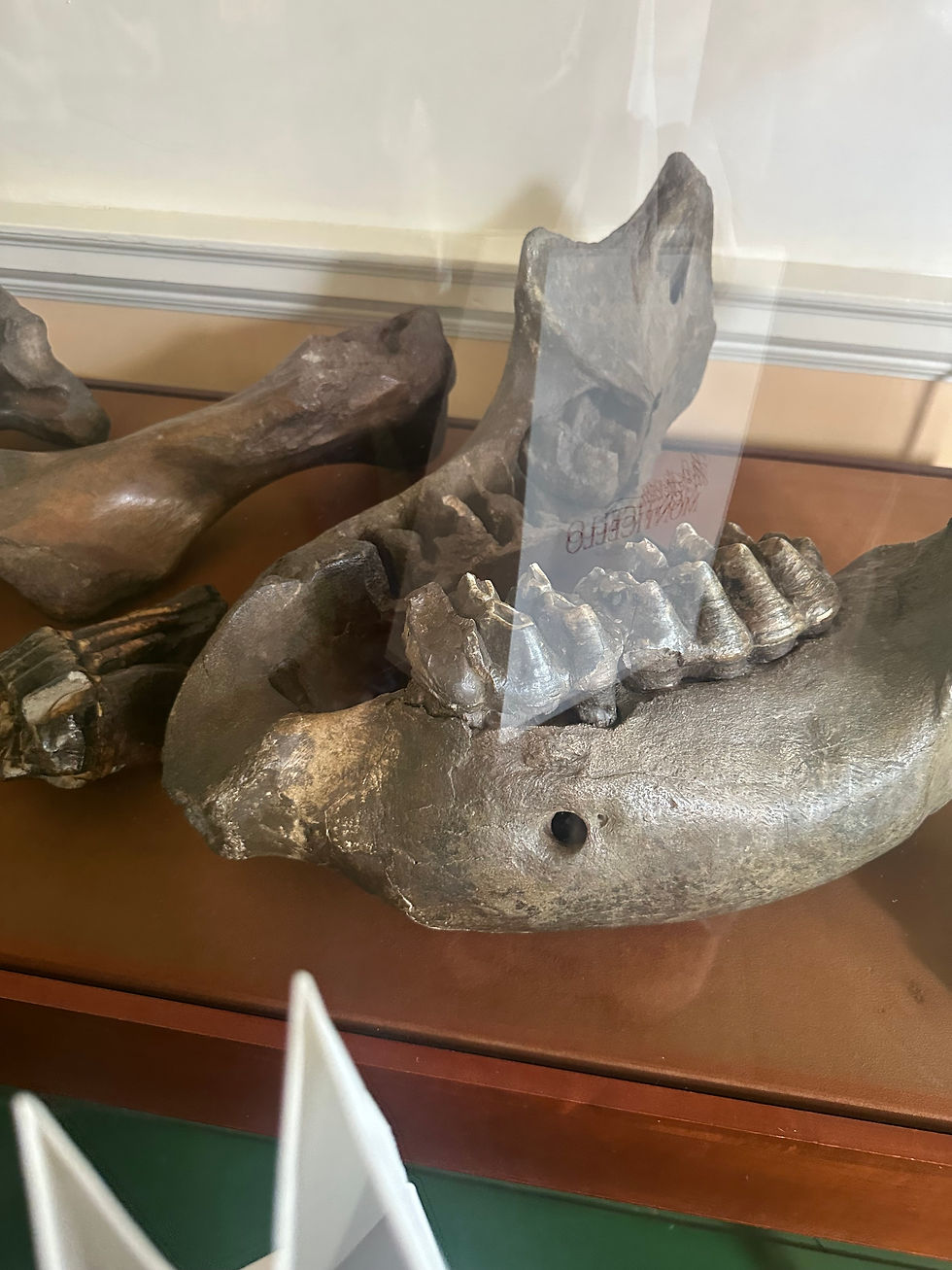
Dark brown fossils sent to Jefferson by his good friends Lewis and Clark.
Fossils sent to Jefferson by Lewis and Clark.
One of the arms of a grand clock Jefferson had installed that ran the length of the room, and told what day it was by what date the weights hung near.
This is the right hand side of a giant clock that spanned the length of the room and was held aloft by a highly decorated stand in the middle of the archway. The weights were connected (and ran) underneath the floor, and as days would pass, the weights would lift. So on Monday, Jefferson could walk in and see the weights hanging at the 'Monday' plaque. It was my most favorite piece, and the crown jewel of the whole room.

The whole of the enterance room.
The clock aforementioned in the whole of the foyer.

From there, we visited the Library.


A hand printing press in the library, complete with pamphlets printed by it, tied as they would've been.
A printing press with pamphlets and how they would've been bound.
One of many bookcases; some are held back by wire, while others - ones Jefferson actually handled, along with his death mask - sit behind plexiglass.
Another favorite was here - the books behind plexiglass are the actual books from Jefferson's extensive collection (~6,000) which he actually read and held. Beside them is Jefferson's death mask. The other books behind wire are period pieces, titles that Jefferson did have in his collection, but not that physical copy.
A small cabinet of antique books.
A sitting/writing area in the library, which Jefferson used as an office.
One of many, many writing/lap/travelling desks dotted around Monticello, there was at least one in every room!
A closer photo to see the wire, as well as Jefferson's death mask.
A closer photo of Jefferson's death mask.
A photo of another bookcase in the room, filled to the brim with books.
More books - I was in heaven!
A harpsichord, lute/mandolin, and violin that all belonged to Jefferson's sister, Martha Jefferson Carr.
This stunning parquet flooring was laid by two men, one paid and one unpaid. It took them nine months to lay the floor, all by hand, and the paid craftsman said he would never do another as long as he lived. I think it was 100% worth it though! I would have it in my home in a heartbeat. The instruments belonged mainly to Jefferson's sister, who lived with him, and was a musical prodigy.

Next we moved to Jefferson's Cabinet and Tea Room.


Jefferson's Tea Room/Cabinet.
A closer shot of the many busts in Jefferson's tea room.

This beauty of a room is just off of Jefferson's bedroom - quite literally - and served as his office, where he would write, tinker, and contemplate.

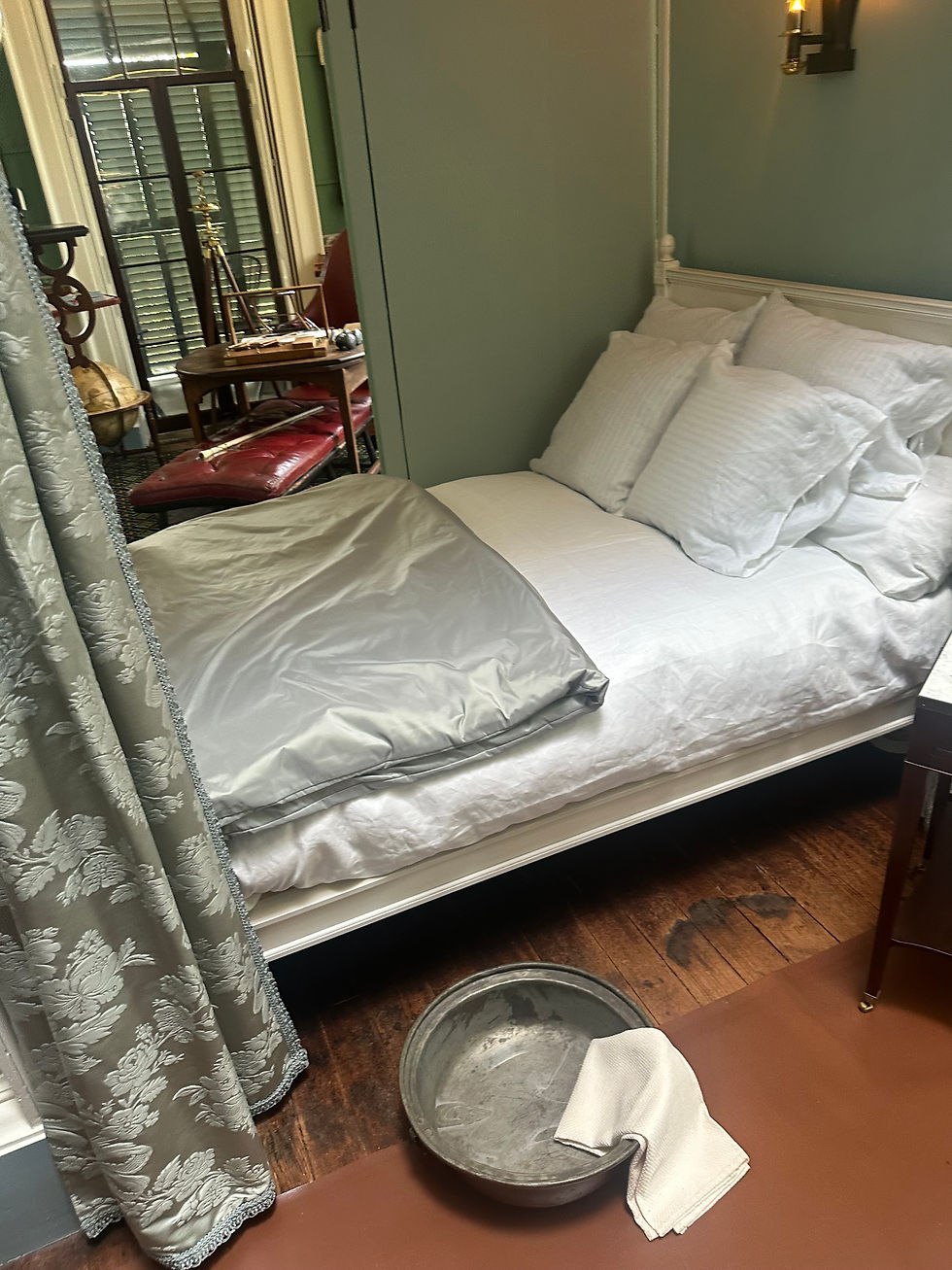
A shot into Jefferson's alcove bed, the design of which he took from the French.
A closer shot into Jefferson's alcove bed, which can close up from all sides.

This type of box-bed was something Jefferson encountered in France and brought back with him when building Monticello. The bed is bookeneded by doors, so its able to be closed up like a box, nestled into an alcove; he loved this design so much that he installed it in all of his guest rooms - except for his sister Martha Jefferson Carr's room - and couldn't understand why anyone wouldn't want to have a bed like that!


Jefferson was also 6ft 4", and so slept in bed sitting upright, propped by his pillows, and started his day by plunging his feet in a bath of cold water.


Next, we visited the dining room.


A shot into the dining room, whose fireplace has two hidden dumbwaiters specifically for wine.
A closer shot of these wine dumbwaiters, located on the sides of the fireplace.
Both sides of this beautiful fireplace open up to showcase dueling dumbwaiters! Jefferson was so paranoid about his staff eavesdropping (and after his time in the French court, I can't say I blame him) that he had these dumbwaiters installed which would send up bottles of wine from the celler below. As well, after dropping off the food, he would send his butlers away and the guests would serve themselves - that way there were no disturbances while he and his guests dined, and at the same time, did business.

Believe it or not, that yellow (named 'chrome yellow') was the original paint color! The stewards of Monticello have been very meticulous about historical paint and wallpaper, which was incredibly appreciated! When we visited, I noticed the baseboards in the upper floors the face of the baseboards were painted a blue-gray - which is historical! Apparently they were painted that color to hide dirt and scuff marks. I had never seen such a thing (of only the face of the baseboards being painted, usually it's the whole of the molding, the crown and baseboard).


Next, we moved upstairs!


The very thin and small staircase that goes to the upper floors of Monticello, and holds all of the other bedrooms.
The stairs are very thin, and there are many of them! If you're planning to visit, bring good walking shoes.
The balcony overlooking the foyer.
The dome room, which was very hot in the summer and very cold in the winter.
On of the most awe inspiring rooms is the Dome Room; it sits under the dome inspired by the Temple of Vesta in Rome, as depicted by Palladio. It includes an oculus and half mirrored windows to hide parts of the house.
A picture showcasing the skylight in the dome room.
Our docent told us that most of the time, the room itself was just used as storage as it was very hot in the summer and very cold in the winter. The brown door you see there actually leads to a tiny sitting room that the women of Monticello (usually Thomas' sisters and late wife) would use to 'get away from the children' even during the heat of summer!
The small sitting room off of the dome room (through the brown doors) which the ladies of the house used for reading, drawing, and getting away from the children.
The aforementioned tiny sitting room.
A view into the back gardens of Monticello through a dome window, which opens outwards.

What I also loved about Monticello is that all of the glass - and you can even see it here - is wavy. All glass was made by the same company which supplies the wavy, period-accurate glass of Colonial Williamsburg.


We dipped out of this room, and into the Nursery room.


The nursery room, with two small, high windows so children could not fall out.

This room was used for all children from infancy to age ten, and their nurse. They believe the smaller, and higher, windows were made that way so no one could accidentally push, or fall, out of the windows.


One of our last stops was Martha Jefferson-Carr's bedroom, one of the grandest upstairs bedrooms in the building.


A wide shot of Martha Jefferson Carr's room, the most grand of the bedrooms upstairs; it features two low, small windows, a vanity, a small desk, and a red toile canopy.
A closer look at the red toile canopy and Martha's bed.
The toile here is 'lit a la Polonaise' and was sent from France specifically. If you notice, Martha does not have a bed like her brother - she couldn't stand the French box bed as it can feel claustrophobic - and so he had this hanging built for her.

Martha Jefferson Carr's wash basin; a blue-and-white toile with large peony and rose floral print.
I just loved her wash basin! The pattern was stunning.

Back down the stairs we went, to the basement levels where there was a kitchen, a privy, and the wine cellar that is attached to the dining room via dumbwaiters.


The wine cellar, filled to the brim with wine.
Wine cellar.
Monticello's kitchens, fully stocked.
Kitchen.
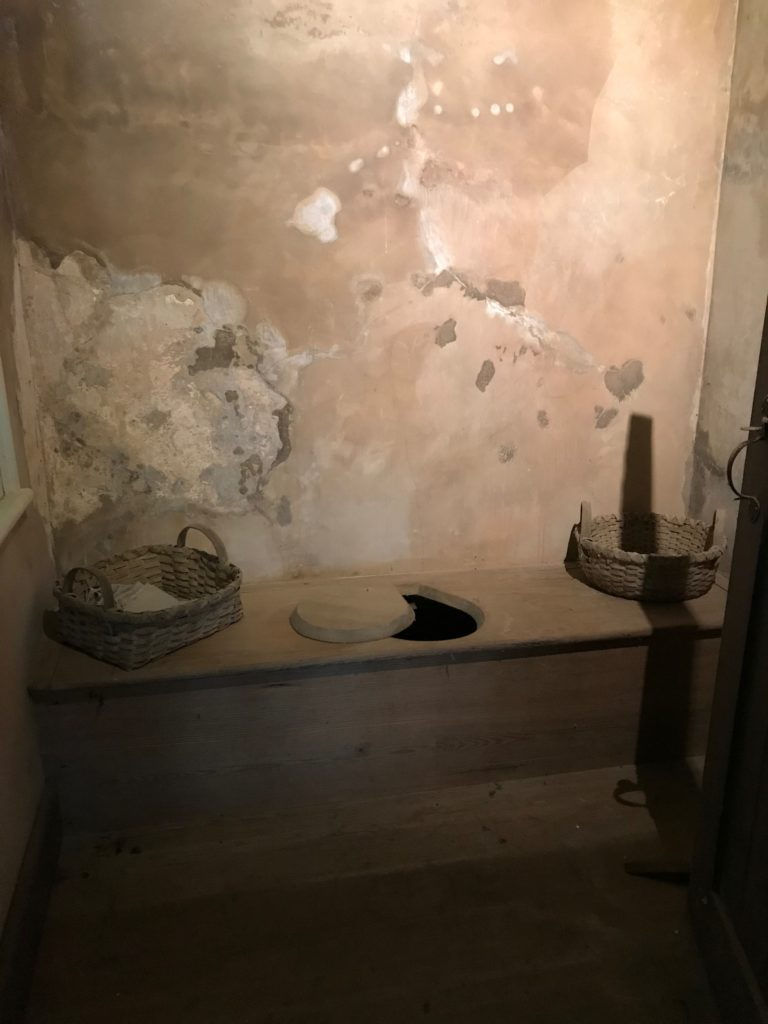
One of Monticello's three privies; the walls are limewashed and there sits baskets of napkins to use.
The Privy. What’s funny is that most houses of this time period did not have indoor facilities, and yet Monticello had three. Two were located on the south side of the house and one was in Jefferson’s bedchamber. They were non-flushing but attached to shafts for ventilation and slaves were paid to clean them.

And so, walking out of Monticello, we were greeted by the stunning day, and the beautiful grounds which keepers are so meticulous to keep up, with great success.


The view down Monticello hill, back towards the museum and gift shop, all covered with trees; the sky is very blue and dotted with puffy clouds.
A closer view of the facade of Monticello; red, white, and blue bunting hangs from the columns.
A further zoomed in view of Monticello, capturing the beauty of the facade and the dome.

After our tours, we disembarked from Monticello and snapped these photos as we started making our way back to the car/downtown Charlottesville.


A high view of downtown Charlottesville, Viriginia, with mountains rolling easy in the background; blue mist sits on the horizon - rain.
Another view of downtown Charlottesville, VA, with historic buildings and high rises; the sky is a yellow gold being misted over by dark clouds and drenching rain.

Running from the rain, we found solace (and delicious food!) in an Applebees, and then set out to check off some of the antique and book stores Jordan picked out for us.


A full set of pink/red transferware plates, bowls, and a sugar bowl made by Wedgwood in 1901.
More beautiful transferware!
The inside of a bookstore, with large bookcases and tables laden with different piles of books. Not an  inch is spared; there are books everywhere.

While there we found transferware, books, ceramic cats (that Jordan, via text, loved) and lots of fun shops! We walked around for a few hours until our ghost tour began, and were swept up in the traffic of a festival called "Tom Tom" (the locals told us it was short for Tomorrow Tomorrow), and found ourselves back at our hotel room, thoroughly pooped but happy.


Monticello was such a lovely trip, and I can't recommend visiting the house and grounds enough! One day we'll take Jordan so she can experience it as well; it's a wonderfully informative, family-friendly place, and the docents were incredibly passionate, dedicated, and knowledgable. Check out the website for more details on Monticello, the history, and all the incredible research these devoted people have put in to preserving and helping this national landmark to flourish.


If you want more historic homes - don't forget to visit Montpelier (James and Dolly Madison's home) which is 30 miles away, or if that's too far, James Monroe's home Highland is only a seven minute jaunt from Monticello! I also found a wonderful digital walkthrough of Mount Vernon - George and Martha Washington's home - when I arrived home, and I will link that as well!


Monticello (Thomas Jefferson), Charlottesville, Virginia - https://www.monticello.org/

Montpelier (James Madison), Montpelier Station, Virginia - https://www.montpelier.org/

Highland (James Monroe), Charlottesville, Virginia - https://highland.org/


bottom of page